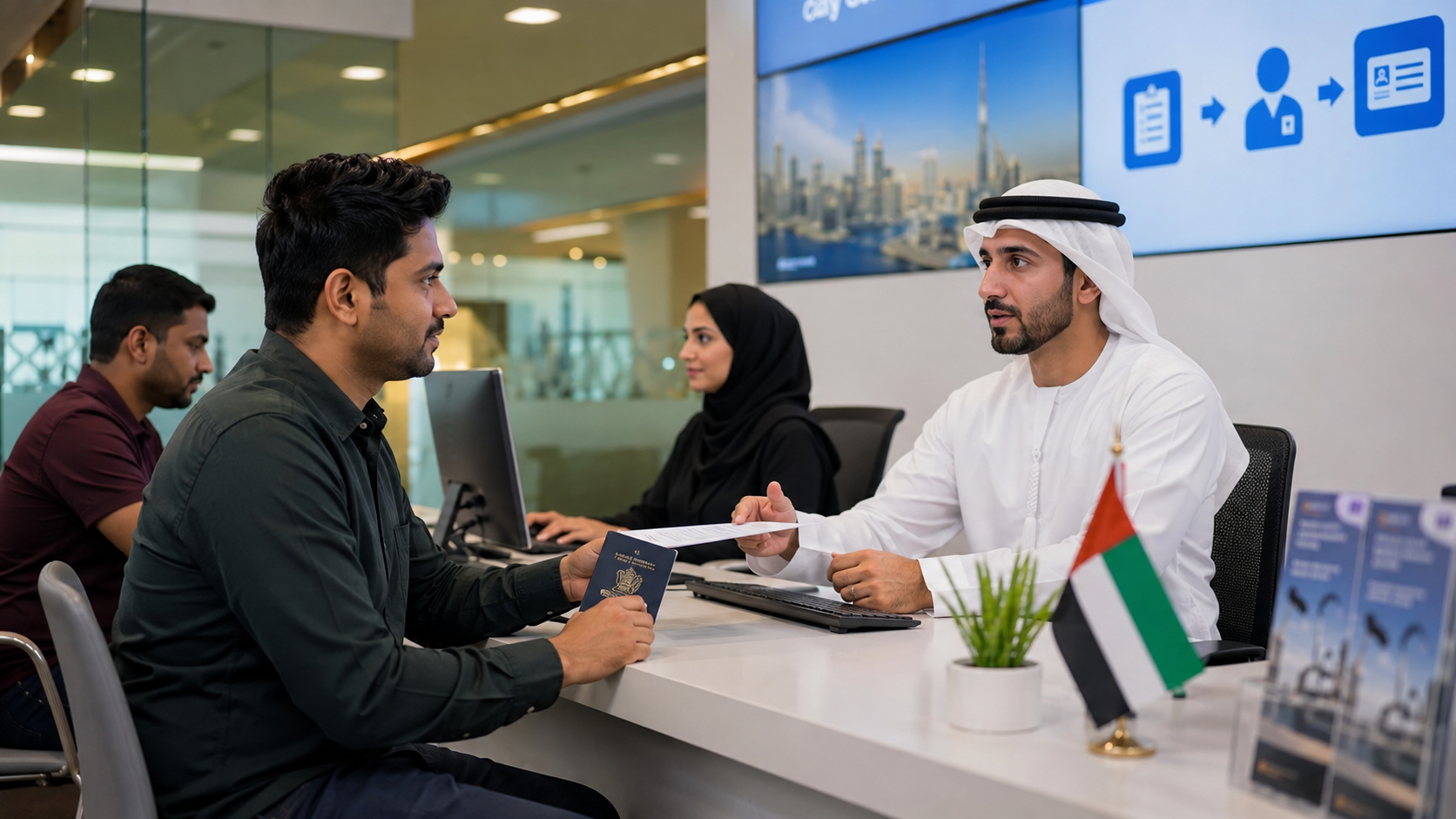
UAE Work Visa Process 2026 – Complete Step-by-Step Guide
Getting a work visa for the UAE is one of the most important steps you will take before starting your career in the Gulf. The process is structured, government-regulated, and entirely managed through your employer — which means you do not need to pay anyone to get it done. What you do need is the right information so you are not caught off guard by paperwork, timelines, or fees.
This guide walks you through the complete UAE work visa process for 2026 — from understanding what the visa actually is, to the documents you need, the steps involved, realistic costs, and the mistakes that slow people down. Whether you are applying for the first time or returning after a gap, this is the information you need before you board that flight.
What Is a UAE Work Visa?
A UAE work visa is an official authorisation that allows a foreign national to live and work legally in the United Arab Emirates. It is not a standalone document you apply for on your own — it is tied directly to an employment contract with a UAE-based employer who acts as your legal sponsor. UAE Work Visa Process 2026.
Once your employer initiates the process, the UAE’s immigration system issues your entry permit, you complete a medical fitness test and biometrics, and your Emirates ID and residence visa are then stamped. The entire process is governed by the UAE Ministry of Human Resources and Emiratisation (MOHRE) and the Federal Authority for Identity, Citizenship, Customs and Port Security (ICP).
A standard employment visa in the UAE is typically valid for two or three years depending on your employer’s free zone or mainland status, and it can be renewed as long as your employment continues.
Types of UAE Work Visas
Not all UAE work visas are the same. The type you receive depends on your employer, the nature of your role, and the economic zone your company operates in.
Mainland Employment Visa
Issued for employees working in companies registered on the UAE mainland. The sponsoring employer files the application through MOHRE and the General Directorate of Residency and Foreigners Affairs (GDRFA). This is the most common type for workers in sectors like construction, retail, hospitality, logistics, and domestic services.
Free Zone Employment Visa
Issued for employees working within one of the UAE’s many free zones such as Jebel Ali Free Zone (JAFZA), Dubai Multi Commodities Centre (DMCC), or Abu Dhabi Global Market (ADGM). Free zone employers manage the visa process internally through their own authority rather than MOHRE. The visa is still a UAE residence visa, but the sponsoring body is the free zone itself.
Mission Visa (Temporary Work Permit)
A short-term work authorisation for professionals sent by a foreign company to complete a specific project or contract in the UAE. It is typically valid for up to three months and is not a pathway to long-term residence on its own.
Green Visa (Self-Sponsored Work Visa)
Introduced as part of the UAE’s updated immigration framework, the Green Visa allows skilled professionals and freelancers to sponsor themselves without needing an employer as guarantor. Eligibility requires proof of a certain level of income, qualifications, and a valid freelance licence or employment offer meeting minimum salary thresholds. It is valid for five years.
Golden Visa (Long-Term Residence)
The Golden Visa is a long-term residence permit valid for 10 years, available to investors, entrepreneurs, specialised talent, and top students. While not a traditional work visa, it allows full legal work rights and does not require employer sponsorship for renewal. Eligibility criteria are specific and set by the UAE government.
UAE Work Visa Requirements 2026
Meeting the eligibility requirements before your employer begins the process saves time and prevents complications later. Here is what the UAE immigration system generally requires:
- Valid passport: Your passport must be valid for at least six months from the date of application. Many employers and immigration officers prefer at least one year of remaining validity.
- Signed employment contract: You must have a formal offer and contract issued by a UAE-licensed company through the MOHRE e-contract system or a free zone equivalent.
- Educational qualifications: For roles requiring a degree or professional certification, your credentials will typically need to be attested by the relevant authority in your home country and then by the UAE Embassy.
- Medical fitness: You will need to pass a medical fitness test conducted at an approved UAE health centre. This test screens for certain communicable diseases as part of the UAE’s public health requirements.
- Clean background: While not always a formal document requirement, applicants with prior deportation orders or criminal records in the UAE will face complications and should seek legal advice before applying.
- Age: There is no universal minimum age beyond the legal working age of 15 in the UAE, but most employers require candidates to be 18 or above. Some sectors have upper age limits depending on the role type and employer policy.
Required Documents for UAE Work Visa
The exact document list can vary slightly depending on your employer, the emirate, and the sector you are working in. Below is the standard set required in most cases:
- Original passport with at least six months validity
- Passport-sized photographs (white background, recent)
- Signed employment contract (MOHRE-attested or free zone equivalent)
- Educational certificates (attested by the relevant authority in your home country and UAE Embassy if required for your role)
- Medical fitness certificate from an ICA/GDRFA-approved health centre in the UAE
- Biometric data (fingerprints and photograph, taken at an approved typing or service centre)
- Entry permit copy (issued after initial employer application approval)
- Emirates ID application receipt
- Completed visa application form (typically processed by the employer on your behalf)
If you are applying for a skilled or professional role, your employer may also request a no-objection certificate (NOC) if you are transferring from another UAE employer. Always get written confirmation from your employer about exactly which documents they need from your side — this avoids last-minute scrambles.
Step-by-Step UAE Work Visa Process
Here is how the standard mainland employment visa process works from start to finish:
Step 1: Job Offer and Contract
Your employer issues a formal job offer and an employment contract that is registered through the MOHRE Tawafuq system. This is the legal binding step — the contract must match what you agreed verbally. Read it carefully before signing.
Step 2: Entry Permit Application
Your employer applies for an employment entry permit through GDRFA or ICP. This is the initial visa that allows you to enter the UAE for residency stamping purposes. If you are already inside the UAE on a visit visa, a status change may be possible without exiting, depending on your visa type.
Step 3: Travel to UAE
Once the entry permit is issued, your employer shares it with you. You then travel to the UAE within the validity period specified on the permit — usually 60 days from issuance. Do not delay your travel unnecessarily, as expired entry permits require the employer to reapply from scratch.
Step 4: Medical Fitness Test
Within a few days of arriving, you will attend a medical fitness test at an approved health centre. The test typically includes blood tests and a chest X-ray. Results are usually available within 24 to 72 hours and are submitted directly to the immigration system.
Step 5: Emirates ID Biometrics
You will be directed to a typing centre or ICA service centre to complete your Emirates ID application and provide biometric data — fingerprints and a facial scan. Your employer typically handles the typing and submission on your behalf, but you must be present for the biometrics in person.
Step 6: Residence Visa Stamping
Once the medical results are cleared and biometrics are submitted, your employer applies for the residence visa stamping. The visa is stamped into your passport and is typically valid for two or three years depending on the company’s structure and the employment category.
Step 7: Emirates ID Collection
Your Emirates ID card is produced separately and either couriered to your address or made available for collection at an ICA centre. It serves as your national identification while in the UAE and is required for almost everything from opening a bank account to signing a tenancy contract.
UAE Work Visa Fees
Visa fees in the UAE are set by government authorities and are paid by the employer in most cases. That said, knowing the approximate costs helps you understand the process and protects you from being asked to pay for things that should not be your responsibility.
Here is a general breakdown of typical costs as of 2026 (fees are subject to change by the relevant authorities):
| Service | Approximate Cost (AED) |
|---|---|
| Employment entry permit | AED 200 – 500 |
| Medical fitness test | AED 300 – 500 |
| Emirates ID (2-year) | AED 370 |
| Emirates ID (3-year) | AED 470 |
| Residence visa stamping | AED 200 – 600 |
| Typing and service centre fees | AED 100 – 200 |
Important: Under UAE Labour Law, employers are legally required to bear the costs of work visa processing for employees they sponsor. If a recruiter or employer asks you to pay any of these fees yourself in advance, ask for this in writing and verify it against your contract terms. For professional roles, some employers deduct visa costs from salary over a period — this must be clearly stated in the contract before you sign.
UAE Work Visa Processing Time
Processing times vary based on the authority handling the visa, the applicant’s nationality, the emirate, and how efficiently all documents are submitted. Here is a realistic timeline to plan around:
- Entry permit approval: 3 to 10 working days after employer application submission
- Medical fitness results: 1 to 3 working days after the test
- Biometrics submission to stamping: 3 to 7 working days
- Emirates ID delivery: 5 to 15 working days after biometrics
- Total process from arrival to full completion: Typically 3 to 5 weeks
Delays most commonly happen when documents are incomplete, when medical results flag something requiring follow-up, or during peak periods such as the start and end of the year when volume across GDRFA and ICA is higher. Starting your document preparation well before your travel date is always the right approach.
Common Mistakes to Avoid
A lot of people run into unnecessary problems during the UAE visa process — not because the system is complicated, but because of easily avoidable missteps. These are the most common ones:
Travelling on an Expired Entry Permit
Entry permits have a validity window — typically 60 days from issue. Some people delay their travel without realising the permit has expired. Always check the issue date and plan your travel accordingly. If your circumstances change, contact your employer immediately so they can apply for a new permit.
Not Attesting Certificates When Required
For roles that require verified qualifications — such as healthcare, engineering, education, or legal — unattested certificates are rejected. The attestation process involves your home country’s education ministry, then the UAE Embassy in your country, and sometimes the UAE Ministry of Foreign Affairs. This can take several weeks, so start the process early.
Overstaying Before the Process Completes
If you entered the UAE on a visit or tourist visa and your employer is processing your residency, you must not overstay your original visa while waiting. Overstaying attracts fines of AED 50 to AED 200 per day depending on the visa type. Coordinate closely with your employer on timing so you remain in legal status throughout.
Signing a Contract You Have Not Read
The MOHRE e-contract is the legally binding document. Whatever salary, role, and terms are written there are what you are entitled to — not what was verbally promised. If the contract does not match your offer, raise it before signing. Making changes after the visa is stamped is significantly harder and requires employer cooperation.
Paying Recruitment Fees
UAE law prohibits charging workers recruitment fees. If a recruitment agent, middleman, or employer asks you to pay to secure a job or get your visa processed, this is illegal under UAE regulations and is a serious warning sign. Genuine UAE employers bear all visa-related costs themselves.
Using Unverified Typing Centres
Document submission should only go through ICA-approved typing centres or directly through your employer. Using unverified services risks data mishandling and application errors that can delay your process by weeks and create complications on record.
Frequently Asked Questions
Can I apply for a UAE work visa on my own without an employer?
For a standard employment visa, no — you need a UAE-licensed employer to sponsor the application. However, if you qualify for the Green Visa as a skilled professional or freelancer, you can self-sponsor. The Green Visa requires meeting specific income and qualification criteria set by the UAE government.
Can I change jobs after getting my UAE work visa?
Yes. Under the updated UAE Labour Law, employees who have completed at least one year of service can transfer to a new employer without requiring a No Objection Certificate (NOC) from their current employer in most cases. The new employer initiates the transfer process. If you leave before one year, an NOC or a grace period restriction may apply depending on the circumstances.
What happens if I fail the medical fitness test?
If you test positive for a condition that disqualifies you under UAE immigration rules, your entry permit will be cancelled and you will be required to leave the country. The specific conditions that lead to disqualification are defined by the UAE Ministry of Health. Some cases may be resubmitted after treatment, depending on the condition and circumstances. Contact your employer immediately if this happens.
How long does it take to get an Emirates ID after biometrics?
Typically 5 to 15 working days. You can track the status of your Emirates ID through the ICA smart app or the ICA website using your application number. In some cases, the ID is couriered to a registered address; in others, you collect it from an ICA service centre.
Can my family join me on a UAE work visa?
Yes, if you meet the salary threshold required to sponsor dependants. As of 2026, the general minimum monthly salary to sponsor a spouse and children is AED 4,000 (or AED 3,000 if accommodation is included in your package). Some free zones have different thresholds. Your employer or an approved typing centre can guide you on the dependent visa process once your own residency is complete.
What should I do if my employer cancels my visa?
When a UAE work visa is cancelled, you typically have a 30-day grace period to either find a new employer and transfer your residency, or leave the country. Do not ignore this window — overstaying after cancellation carries fines and could affect future UAE visa eligibility. If you believe the cancellation was unfair, MOHRE has a formal dispute resolution mechanism you can use.
Final Thoughts
The UAE work visa process in 2026 is structured, transparent, and entirely manageable when you go in prepared. Your employer handles most of the heavy lifting — your job is to have the right documents ready, respond quickly when asked, and make sure your contract reflects exactly what you were offered before you sign it.
Understanding each step before you arrive — what happens at the medical, what the MOHRE contract means, how long the Emirates ID takes — removes the anxiety that often surrounds the process. The UAE’s immigration infrastructure is digital, fast, and well-organised for most applicants. What causes delays is almost always avoidable: missing documents, expired entry permits, or waiting too long to act after arriving.
If you are offered a genuine role by a UAE-licensed employer, the process will proceed as described in this guide. Stay informed, maintain close communication with your employer’s HR team, keep copies of every document you submit, and make sure everything in your contract matches what you were promised. That is all the preparation you really need.
For official and up-to-date information on UAE work visas, visit mohre.gov.ae and icp.gov.ae.